Isle of Harris Gin
Last updated 26 October 2026
The bottle that launched a thousand Instagram posts. Isle of Harris Gin uses sugar kelp hand-harvested from sea lochs around Harris as its signature botanical. The community-owned distillery in Tarbert has done more for the island’s economy than any other single business.
The Isle of Harris bottle is genuinely beautiful and the community-owned distillery is genuinely good for Harris. The gin itself is well-made, with a subtle and honest sugar-kelp character — but at £40+ it’s priced for the bottle and the brand more than the dram. As a gift it’s hard to beat. As a daily drinker, The Botanist is better value.
Is Isle of Harris Gin worth it?
The honest comparison
Set against The Botanist (£37 on its own shop, Islay, 46% ABV) and Caorunn (£30.50 at Morrisons, Speyside, 41.8% ABV) — the top two gins from our gin guide — the differences are clear on paper and in their documented profiles.
Distinctiveness: Harris wins. Neither The Botanist nor Caorunn has anything like the kelp note. If you're looking for a gin that tastes meaningfully different from everything else, Harris delivers.
Value for money: Harris loses. On the prices we could read on 31 October 2026 (£44.50 for Harris on the distillery shop), The Botanist is a more complex, more versatile gin for £7.50 less, and Caorunn is a brilliant everyday gin for £14 less at Morrisons' regular price. Harris is 45% ABV against The Botanist's 46% and Caorunn's 41.8%. The Harris premium is paying for the story, the bottle, and the scarcity — not for a proportionally better liquid.
Versatility: The Botanist wins. It works in every application — G&T, Martini, Negroni, Collins. Harris is excellent in a Martini and good in a G&T but the savoury kelp note doesn't suit every cocktail.
What you're actually paying for
Let's be honest about the £44.50 price tag:
The bottle. The Isle of Harris bottle is expensive to produce — custom-moulded, heavy glass, distinctive closure. Bottle design is a significant percentage of the retail price for small-batch spirits.
The location. Running a distillery on Harris — one of the most remote inhabited islands in Scotland — costs more than running one in Edinburgh or Speyside. Shipping materials in and product out is expensive. Staff have to live on an island with limited housing. These are real costs.
The story. A distillery on Harris, using hand-dived sugar kelp, supporting an island community. This is a story that sells. It's also, on the available evidence, a genuine story — the distillery does employ locals, they do use island ingredients, and the business does contribute to the Harris economy.
Scarcity, once. For years Isle of Harris Gin was frequently allocated or sold out, and that helped the premium positioning. Supply has widened since — the distillery announced Sainsbury's and Waitrose listings in spring 2026, and the gin was in stock on its own shop on 31 October 2026.
How to taste the kelp note properly
The kelp character is subtle and easily missed. To actually identify it:
- Pour 30ml into a Glencairn or copa glass at room temperature.
- Smell once briefly, then leave for two minutes for the alcohol to mellow.
- On the second nose, look for a light, savoury, almost broth-like note underneath the juniper. That's the kelp.
- Sip a small amount. The sugar kelp shows up most clearly on the back palate and the finish — there's a faint, almost umami impression that lingers after the citrus and juniper have faded.
- Now pour a 30ml of any standard London Dry next to it (Tanqueray, Bombay Sapphire — supermarket fine) and compare. The contrast is what makes the Harris character obvious.
Most G&T drinking dilutes the kelp note to the point where it's barely there. If you've bought a bottle and you don't taste anything special in your usual G&T, that's why. Try a Martini or a small straight pour first.
What about the Hearach whisky?
The distillery launched its first single malt — The Hearach — in late 2023 after eight years of patient maturation, and the whisky side has grown up fast since: in July 2026 it added a new signature dram, the Isle of Harris Single Malt, at £50 RRP — a deliberately more approachable entry point than The Hearach, lightly peated and matured in bourbon and Oloroso sherry casks. The honest take on the Harris malts overall: young, lightly peated Hebridean whisky that shows real promise but isn't yet competing with established Hebridean distilleries like Talisker or Tobermory. It will get better as the stock ages.
If you're curious about the whisky, the new £50 Single Malt is now the sensible way in — no ballot, no secondary market. If you're paying secondary-market prices for a Hearach limited edition just to try the distillery's malt, you're better off buying something more proven for the same money. The gin remains the better-established expression of the distillery's character.
So is it worth it?
If you've never tried it: buy one bottle. The kelp botanical is genuinely novel, the Martini serve is excellent, and supporting a remote island distillery is a good thing. Consider it a £44.50 experience rather than a £44.50 bottle of gin.
If you're thinking about making it your regular gin: don't. At £44.50 a bottle versus £37 for The Botanist or £30.50 for Caorunn, the maths doesn't work for regular drinking. The novelty of the kelp note fades after the first few G&Ts, and what you're left with is a good-but-not-exceptional gin in a very expensive bottle.
If you're buying it as a gift: yes, absolutely. The bottle is the best-looking spirit on any shelf, the story is genuine and easy to tell, and it's the kind of thing people are pleased to receive. As a gift, the presentation premium is a feature, not a bug.
The honest bottom line: for everyday pouring, the value picks — Caorunn or The Botanist — win comfortably on price. As a one-off experience or a gift, the Isle of Harris bottle earns its premium: a genuinely distinctive sugar-kelp gin in the best-looking bottle on the shelf, with a real island story behind it.
The Botanist (our #1) Caorunn (best value)Tasting notes
A clean, dry contemporary gin with a subtle marine umami from the sugar kelp. The bottle is honestly more famous than the liquid — the gin itself is good but not transformative. The kelp character is restrained; you’ll notice it more in a martini than a G&T.
- Nose
- Juniper, fresh citrus peel, faint marine note
- Palate
- Dry juniper, gentle citrus, coastal umami in the mid-palate
- Finish
- Medium length, faintly briny, clean
Flavour profile
- juniper3/5
- citrus2/5
- floral1/5
- herbal2/5
- spice2/5
- sweet3/5
Botanicals
Nine botanicals built around hand-harvested sugar kelp from the sea lochs of Harris — the only gin to use this botanical as a signature
How it’s made
- Production
- Distilled in a single copper pot still in Tarbert. Sugar kelp is hand-harvested from the sea lochs of Harris by local divers and steeped in the gin during distillation.
- Still type
- Single copper pot still
- Base spirit
- Neutral grain spirit
Perfect serve
Walter Gregor’s tonic, pink grapefruit peel, heavy tumbler.
- Garnish
- Pink grapefruit peel
- Ratio
- 1:3
- Ice
- Big cubes — the gin can take cold without falling apart.
The classic Isle of Harris serve uses pink grapefruit instead of lemon — it lifts the juniper and works with the marine note. A subtler tonic lets the kelp come through.
Cocktails to make with Isle of Harris Gin
Harris Martini
Coupe
- 60ml Isle of Harris Gin
- 10ml dry vermouth
- Pink grapefruit peel
Stir gin and vermouth with ice for 30 seconds. Strain into a chilled coupe. Express grapefruit oils over the surface and drop the peel in.
Food pairings
The marine note pairs with seafood beautifully — this is the gin to pour next to a plate of Scottish shellfish.
- Hand-dived scallops
- Fresh oysters
- Seared sea bass
- Smoked mackerel pâté
Where to buy
Supermarket availability
| Supermarket | Stocked | Typical price |
|---|---|---|
| tesco | Yes | — |
| sainsburys | Yes | — |
| waitrose | Yes | — |
Visit the distillery
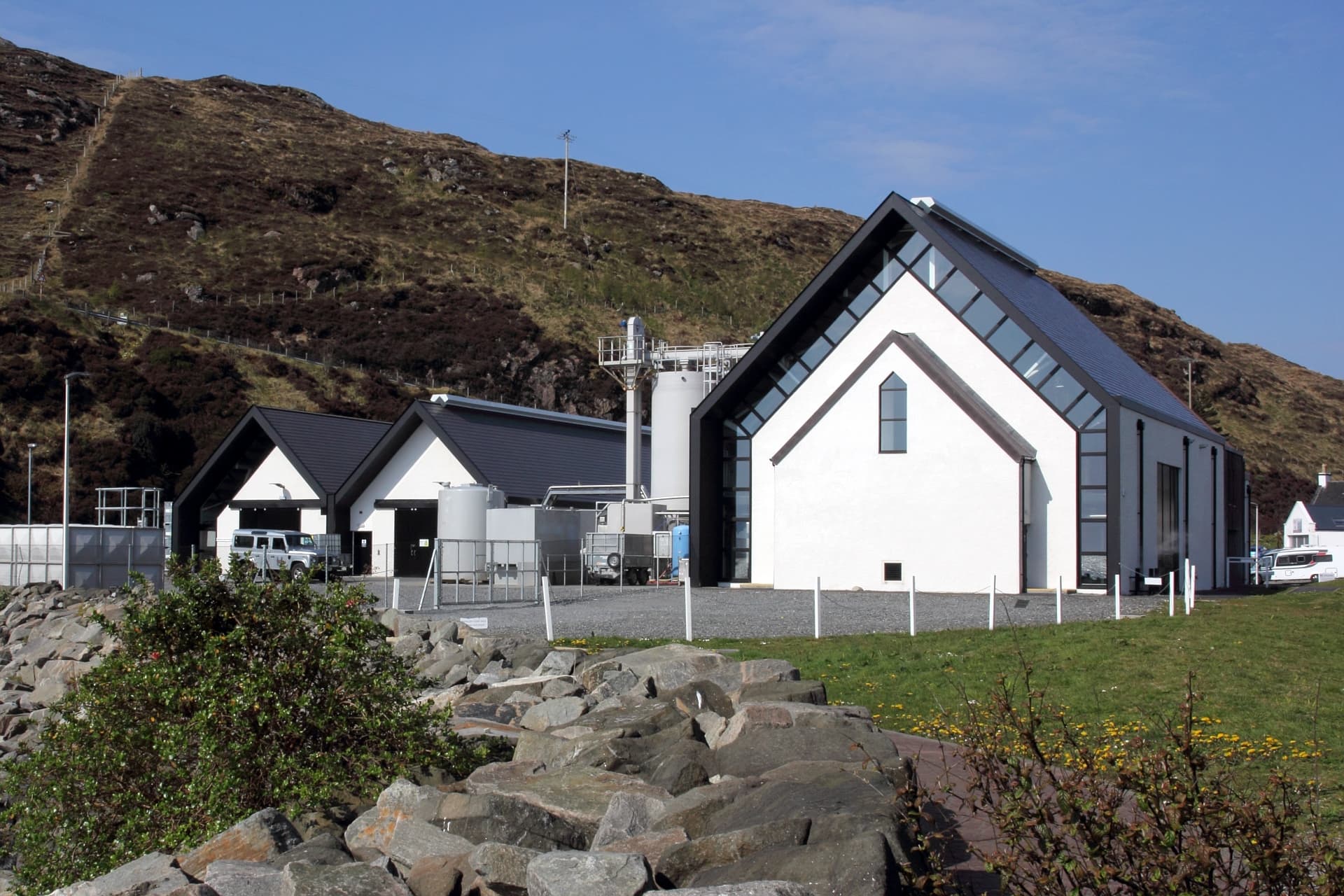
The distillery in Tarbert is one of the most attractive working distilleries in Scotland. Tours include the still room, a guided tasting, and time in the on-site canteen. Worth combining with a Harris road trip.
From £35
Book a tourFrequently asked questions
+Why is Isle of Harris gin so expensive?
A combination of small-scale production on a remote island, hand-harvested sugar kelp, the famously expensive bottle, and very strong demand. At £40+ you’re paying for the bottle and the story as much as the gin.
+Where can I buy Isle of Harris gin?
Direct from the Isle of Harris Distillery shop (online or in person), Master of Malt, The Whisky Exchange, and Waitrose. Tesco lists it as an online grocery line on tesco.com (checked August 2026). Shelf stock is intermittent in supermarkets — the distillery shop is the most reliable option.
+Is Isle of Harris gin worth the price?
For a gift or a special occasion, yes — it’s a beautiful bottle and a good gin with a story. As an everyday G&T pour, no — The Botanist gives you more for less. Buy it for the bottle and the kelp.
+Can you visit the Isle of Harris Distillery?
Yes. The Tarbert distillery runs bookable experiences, including the Isle of Harris Gin Experience (£35 per person) and the Harris Distillery Experience (£50); the 2026 experience season ran 30 March to the end of October, so check dates for winter visits.
+Is Isle of Harris Gin sold in Tesco?
Tesco listed it online in August 2026 (not confirmed since, and not a guaranteed shelf line); otherwise buy direct from the distillery or a specialist retailer.
+Is the sugar kelp actually hand-dived?
Yes. The distillery contracts a local diver who hand-harvests the kelp from beds around the Hebrides. It is one of the few story elements in Scottish gin that is straightforward to verify rather than marketing.
+Does Isle of Harris Gin go off?
An unopened bottle keeps indefinitely. Once opened it is stable for at least two years if stored cool and out of direct light, but the kelp note may fade over six to twelve months, so drink it within a year of opening to taste it at its best.
+Is the gin made by the same distillery as the whisky?
Yes, both come from the distillery in Tarbert. The gin launched in 2015 to fund the distillery during the long wait for its whisky to mature; The Hearach single malt followed in 2023.
Compare with similar gins
The Botanist
contemporary · Islay
Made at the Bruichladdich whisky distillery on Islay, distilled with 22 hand-foraged Islay botanicals on top of nine classics. Run through the same 'Ugly Betty' Lomond still that's now spent more time making gin than the whisky it was originally built for.
Hendrick’s
contemporary · Lowland
The gin that kicked off the contemporary-style boom in the early 2000s. Made at William Grant's Girvan distillery in Ayrshire using two different stills — a Carter-Head and a copper pot — before blending. The unusual dark apothecary bottle was designed to stand out, and twenty years later it still does.
Rock Rose
contemporary · Highland
Distilled at Dunnet Bay in Caithness, just down the road from John o'Groats. Rock Rose uses local botanicals including rhodiola rosea — the wildflower that gives the gin its name and a distinctive earthy character.
Where to stay near Isle of Harris Distillers
The map is centred on Isle of Harris Gin's distillery — set your dates on it, or go straight to hotels, B&Bs and self-catering through the providers underneath.
Booking links are affiliate links — we earn a small commission at no extra cost to you.
Plan your distillery visit
Near Isle of Harris Gin
Things to do nearby, from our sister site TripSCOT, which covers the day-out side. Distances are in a straight line from Isle of Harris Gin, not by road.
Related articles
10 min read
Scottish Gin in the Supermarkets: Which Shop Stocks What
Which Scottish gins the UK supermarkets list — what Morrisons has and charges today, what the distilleries say about Harris at Waitrose and Sainsbury's, and why the rest is worth checking before you go.
8 min read
Glaswegin Guide: Glasgow's Supermarket Gin
Glaswegin is the Glasgow gin people look for in the supermarket. What's actually in it, who makes it, how it tastes, where to buy it, and whether it beats Edinburgh Gin and Makar.
7 min read
Caorunn Gin Guide: The Best-Value Premium Scottish Gin?
Caorunn is Scotland's apple-led gin — distinctive, dry, properly Scottish, and usually cheaper than the famous contemporary gins it gets compared with.